
How to choose your first automatic watch: a guide tailored to your profile
Buying an automatic watch is much more than a simple purchase: it's a symbolic passage. It's discovering an object that lives, beats, and ages with you, a precision mechanism that transcends time without ever relying on a battery.
But then, how do you choose the right automatic watch?
Between movements, sizes, styles, and brands, the choice can quickly become complex. Yet, a few simple principles can help you find the right one:
- Define its use: daily wear, work, sport, or special occasions?
- Choose a reliable movement: Japanese (Miyota, Seiko), Swiss (Sellita, ETA), or Chinese (Seagull).
- Find the right style: sporty, dressy, minimalist, or technical.
- Match the size to your wrist: 39 to 42 mm for optimal comfort.
- Think long-term: a well-maintained automatic watch lasts a lifetime.
At Maison du Temps, we believe that a watch is chosen as much with the heart as with reason. It must reflect your personality and accompany every moment without ever going out of style. In this guide, we will help you understand the fundamentals of the automatic watch, and especially identify the model that truly suits you according to your profile: whether you are curious, an aesthete, a mechanical enthusiast, a sports person, or a budding collector.
Defining the right criteria before buying your first automatic watch
When buying your first automatic watch, you often let yourself be guided by aesthetics, brand, or price. However, these elements are not enough to guarantee a good choice. A beautiful watch can turn out to be disappointing if it's not comfortable, too heavy, or simply disproportionate on the wrist. Before being seduced, it is therefore essential to understand the criteria that truly matter. These are what will make the difference between an impulse buy and a piece that you will enjoy wearing for years to come.
Key criteria to consider
- The brand: it reassures, but doesn't tell the whole story. It's better to choose a young company that prioritizes the selection of its components and assembly quality, like MaisonDuTemps, rather than a prestigious logo at the expense of mechanical content.
- The quality of materials: 316L stainless steel, mineral or sapphire glass, and a well-fitted strap ensure robustness and comfort. These technical details guarantee the longevity of your watch.
Case size: the most frequently mischosen criterion
This is one of the most common pitfalls for a first purchase. A watch that is too large overpowers the wrist and loses all elegance; a watch that is too small appears disproportionate and lacks presence. The right size is one that naturally blends with your movements and fits your body shape without constraint.
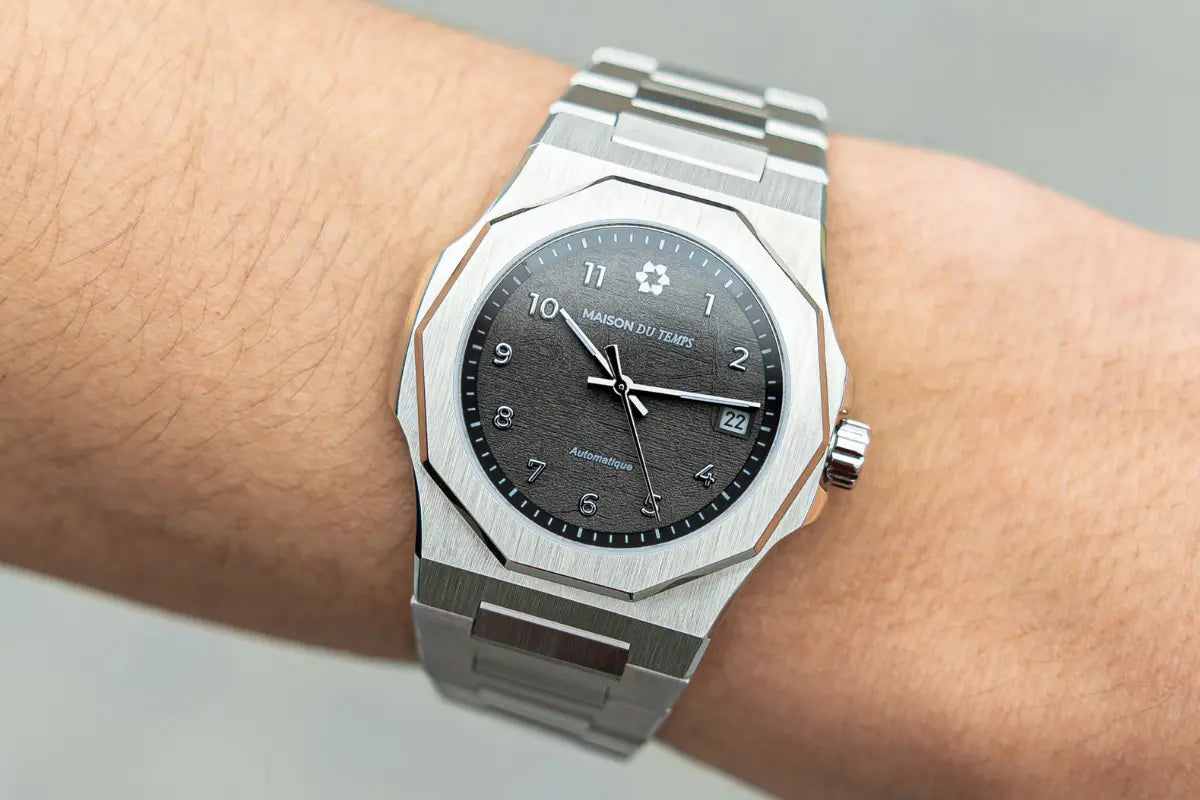
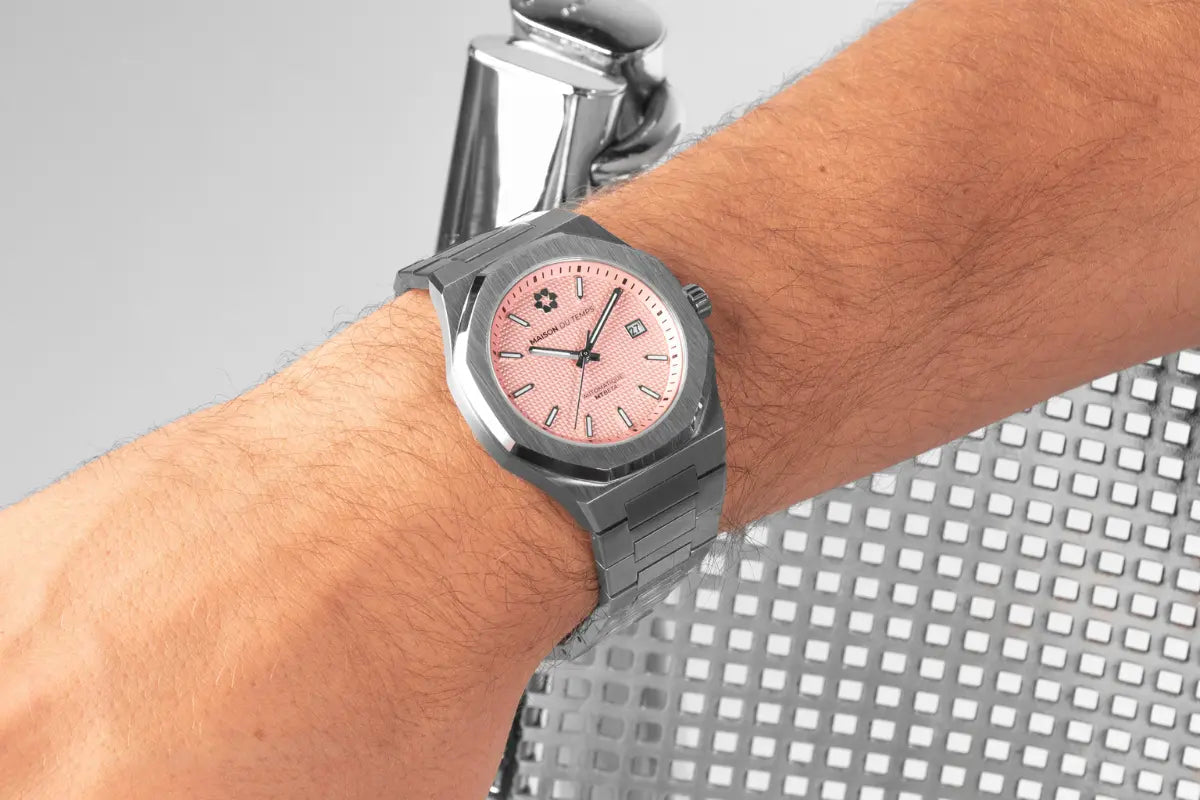
As a general rule, a diameter between 39 and 42 millimeters suits most men's wrists. Slender wrists will achieve a better balance with a more contained case, around 38 to 40 mm, while larger wrists will easily accommodate 42 to 44 mm. But beyond the numbers, it's the feel that matters: the watch should feel like a part of you, neither heavy nor cumbersome.
A size error is often what leads to abandoning an otherwise superb watch. At Maison du Temps, we pay particular attention to this balance. Our models are designed to offer an assertive yet always harmonious presence, regardless of wrist morphology.
Choosing an automatic watch means learning to observe these details. They are what transform a beautiful object into a personal and durable piece. The right movement, the right size, the right comfort: these are the foundations of a successful first purchase, one that will inspire you to delve deeper into the world of mechanical time.
Understand what an automatic watch is before choosing one
Before talking about style, price, or brand, you must first know what you are truly buying. Many buyers confuse automatic, mechanical, and quartz watches, yet everything starts from there: understanding how an automatic watch works means understanding what justifies its price, its reliability, and its particular charm. It's also what allows you to avoid the most common mistakes when making a first purchase.
A living watch, powered by wrist movement
An automatic watch is a mechanical watch that operates without a battery. It winds itself thanks to the natural movements of the wrist: each gesture activates an internal rotor that recharges a spring, thus storing the energy needed to turn the hands. In other words, it is a living watch, drawing its energy from the rhythm of the person wearing it.
A horological heritage between tradition and innovation
This self-winding principle, invented in the 18th century and perfected in the 20th, profoundly transformed the way time measurement is conceived. Unlike quartz watches, which depend on an electronic battery, the automatic watch relies on an entirely mechanical mechanism: an assembly of gears, springs, and wheels of fascinating precision.
This millimeter-perfect ballet is often visible through a transparent case back, where the rotor turns with the movements of the wrist. This transparency is not just aesthetic: it expresses the beauty of the gesture and the mastery of watchmaking craftsmanship.
The symbol of a different art of time
Beyond the technical aspects, the automatic watch represents a certain philosophy. It embodies the meeting between the rigor of engineering and the poetry of passing time. It captivates both watch enthusiasts and lovers of beautiful objects, because it doesn't just tell time: it tells a story, that of the link between man and mechanics.
Owning an automatic watch means reconnecting with a certain form of deliberate slowness, a return to the essential and the beauty of perpetual motion. It is also an almost meditative pleasure: observing the hand glide smoothly, feeling the weight of the steel, listening to the discrete beat of the mechanism.
A durable and emotional choice all at once
Finally, an automatic watch stands out for its longevity. Well-maintained, it can function for several decades, sometimes even being passed down through generations. It is this durability, combined with the nobility of the movement, that makes it both a rational and deeply emotional choice.
Buying an automatic watch is ultimately choosing an object that not only measures time, but also accompanies it – a mechanism that continues to beat as long as one continues to live.
Understanding how an automatic watch works means grasping its soul and its appeal. But before making a purchase, you still need to know what truly differentiates a good model from a simple beautiful object. That's where the selection criteria come into play.
Essential criteria before buying your automatic watch
| Criterion | Why it's important | What to aim for |
|---|---|---|
| Movement | Determines reliability and precision | Japanese movements (Miyota, Seiko) or Swiss (Sellita, ETA) |
| Case size | Influences comfort and visual balance | 39 to 42 mm for an average wrist |
| Style | Resonates with your personality | Sporty, dressy, minimalist, or technical |
| Strap | Impacts comfort and durability | Silicone or steel |
| Maintenance | Guarantee of longevity | Service every 4 to 6 years |
Get inspired by those who found their first automatic watch
Every watch enthusiast has a different story. Some fall in love with a dial by chance in a shop window, others have been searching for a specific model for months. And then there are those who knew nothing about watches but fell in love with one that suited them.
At Maison du Temps, we see these first purchases transform into genuine discoveries every day.
Paul chose a simple, reliable automatic watch to celebrate his first promotion. Julie wanted an elegant model, discreet enough for work, yet assertive enough for evenings. Karim, a mechanics enthusiast, spent hours observing his watch's movement through the transparent case back.
All of them found in their watch more than an accessory: a way to reconnect with time, with themselves, and with the beauty of the gesture.
Understanding technical criteria is one thing. But the true choice of an automatic watch is not limited to a technical sheet: it also depends on a lifestyle, an emotion, a desire. Because a watch is chosen not only for what it is, but for what it says about you.
To help you better envision yourself, we have created several examples inspired by those who have taken this step: men and women who, like you, sought their first automatic watch and found one that matched their way of living time.
The Curious: discovering automatics without breaking the bank
Paul, 28, wanted a mechanical watch "to see the difference." He didn't know much about horology but wanted to understand that unique sensation: feeling the watch live to the rhythm of his wrist. His goal? To find a simple, reliable, and affordable model that could accompany him every day without constraint.
For a first purchase, he opted for a Japanese Miyota movement — known for its robustness — and a versatile design, halfway between sport and elegance. This is often the right approach to start with: choosing an intuitive, well-balanced, and easy-to-wear watch for any occasion.
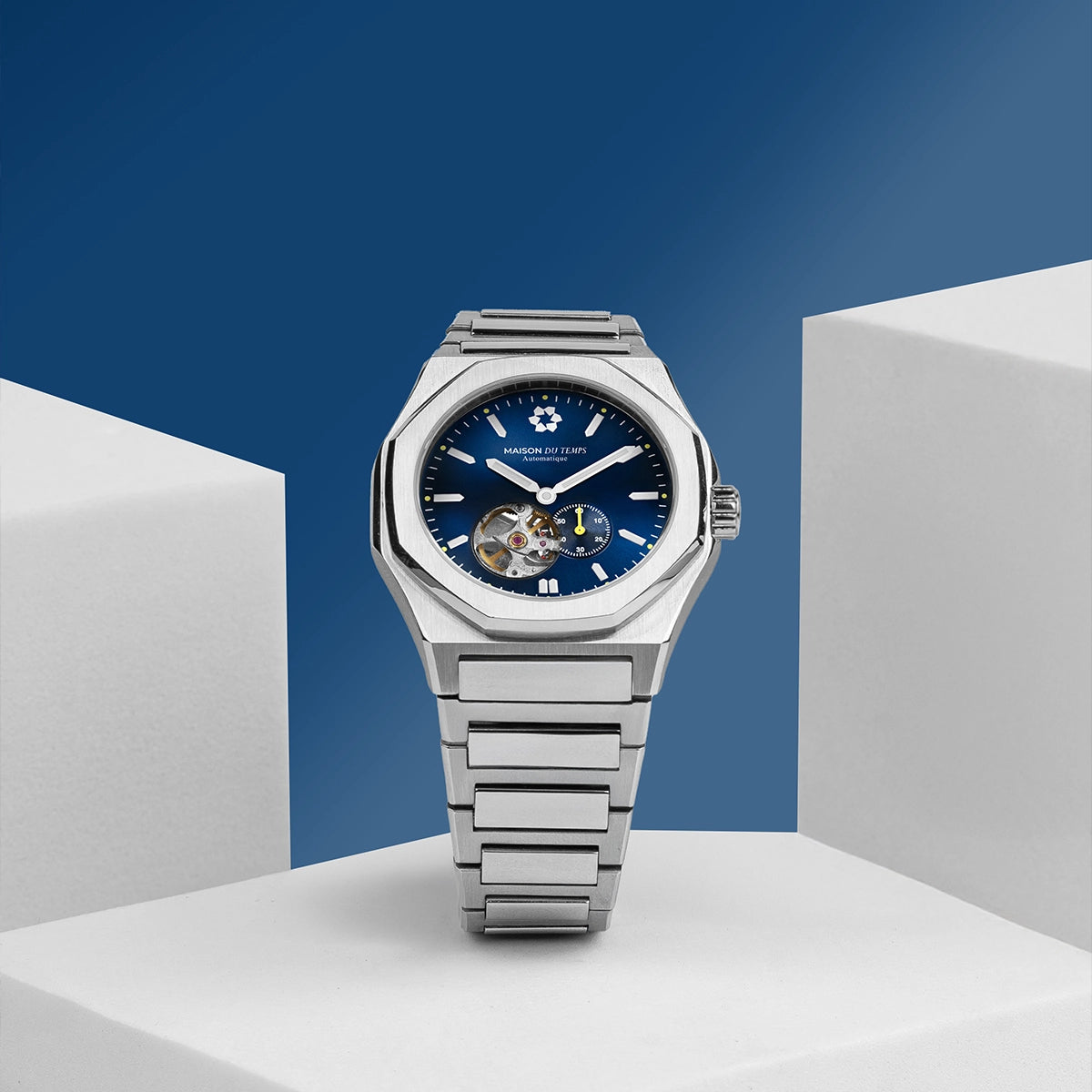
Maison du Temps Recommendation: MTBeta Skeleton Silicone Blue
An accessible and reassuring automatic watch, perfect for taking your first steps into the mechanics of time.
The Aesthete: the watch as a style signature
Julie, 32, sought an automatic watch the way one seeks a piece of jewelry. Not for the technical aspect, but for the allure. She wanted a piece she could wear equally well with a white shirt or a suit, and that would catch the eye without ever being ostentatious.
For her, the choice of dial and finishes is paramount: a watch must reflect natural elegance, a sense of detail. Openwork or clean-lined models are often the most appropriate: they highlight personality without disguising it.
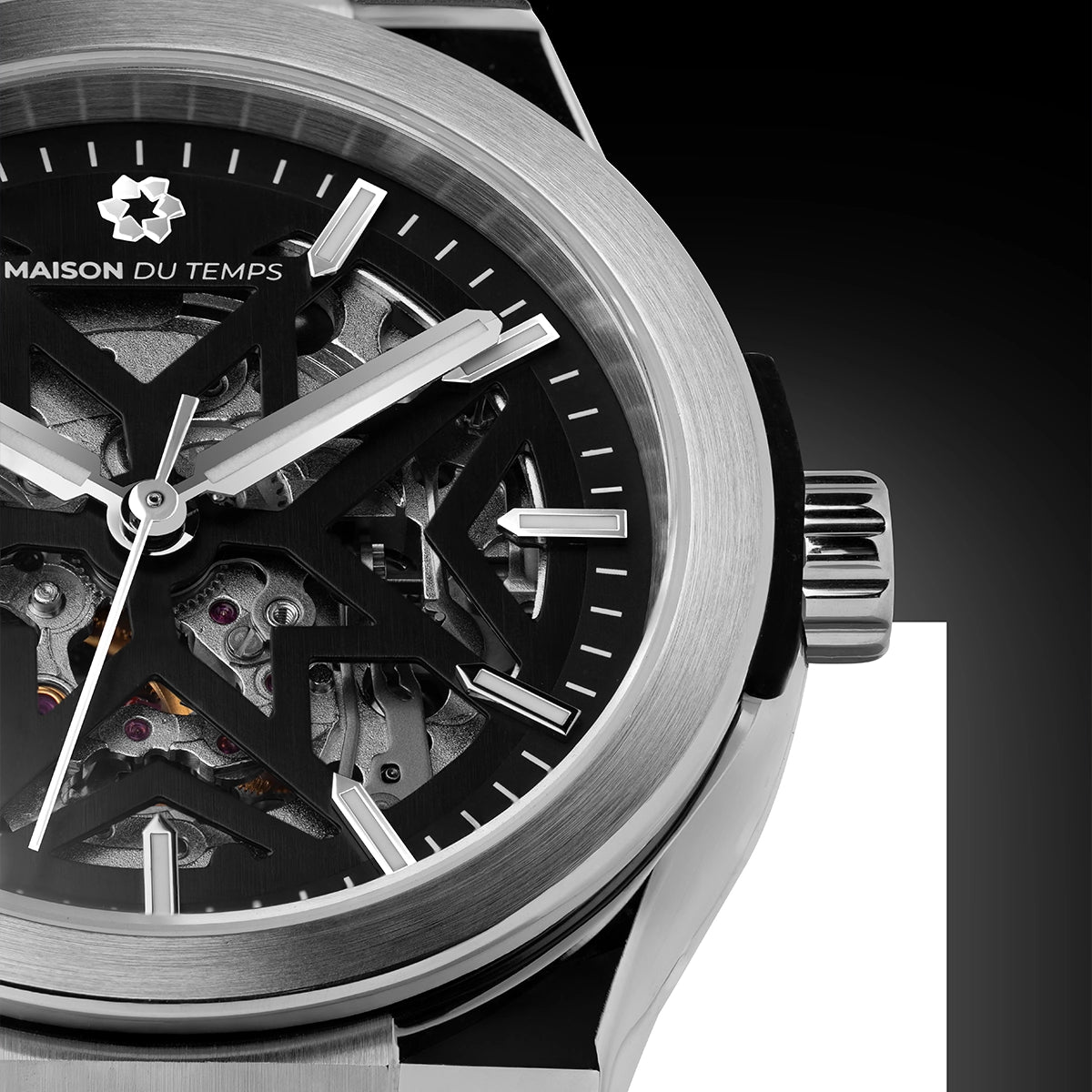
Maison du Temps Recommendation: MTBeta Skeleton Black edition Steel. A watch that is both understated and expressive, where the movement is displayed as a design element.
The Mechanics Enthusiast: fascinated by movement
Karim, 35, became interested in horology for its technical beauty. What he loves isn't just wearing a watch: it's observing its heart beat. He spends hours watching the rotor turn, listening to the regular tick-tock of the movement, understanding how each part interacts with the next.
Skeleton watches are made for him. They reveal the precision of the movement and the poetry of engineering. For an enthusiast, the pleasure lies in this transparency: wearing a watch is also contemplating time in action.
Maison du Temps Recommendation: MTBeta Skeleton Silicone Red .An open-dial model, technical and expressive, designed for those who love to understand time.
The Sportsperson: the watch as an everyday partner
Lucas, 29, didn't want a collector's watch, but an everyday companion. A sturdy watch that he could keep on his wrist during a sports session, a business trip, or an impromptu weekend. He was looking for a model that was comfortable, resistant, and elegant all at once.
For him, the right choice relies on robustness: a steel case, water resistance of at least 5 ATM, and a comfortable silicone strap. This type of watch must withstand the rhythm of daily life without ever losing its luster.
Maison du Temps Recommendation: MTBeta Skeleton Silicone Blue. A robust and elegant automatic watch, designed for those who live their days intensely.
The Budding Collector: a watch to start a story
Adrien, 40, didn't buy his first automatic watch for the time it tells, but for the story it narrates. He wanted a piece that could last, age with him, and perhaps even be passed down one day. His choice naturally gravitated towards a watch with a strong personality, a proven movement, both classic and modern.
The budding collector often seeks a symbolic watch, a reference piece that will serve as a foundation for a future collection. It's a passionate, almost initiatory approach: starting with a watch you truly love, and not one dictated by trends.
Maison du Temps Recommendation: MTBeta Skeleton Black Edition Steel A timepiece with perfect balance, between watchmaking tradition and contemporary design.
Discovering your profile helps you understand what you're looking for in a watch: a style, a use, an emotion. But even with the best intentions, certain choices can lead to disappointment. Automatic watches are precise, sensitive objects, built to last provided a few common mistakes are avoided, which, unfortunately, often spoil the first watchmaking experience.
Before making a purchase, let's take a moment to review the five most common pitfalls encountered by those discovering the world of automatics.
Mistakes to avoid before buying your first automatic watch
Buying your first automatic watch is often a moment of excitement, sometimes impatience. You want to treat yourself, you try to do it right, but a few missteps are enough to choose a model that doesn't really meet your expectations. Here are the five most common mistakes — and how to avoid them.
1. Relying solely on the brand
This is the most common temptation. Big brands inspire confidence, but a name doesn't always guarantee the quality of the movement. Some houses focus more on design or reputation than on mechanical precision.
The right approach: First, look at the heart of the watch — the movement. It is what determines its real value. At Maison du Temps, we have chosen the Japanese Miyota movement for its robustness and reliability, proven over decades.
2. Ignoring wrist size
A watch that is too large or too thick immediately unbalances the wrist and loses elegance. Conversely, a model that is too small seems lost and lacks presence. Case size is an essential criterion, often underestimated.
The right approach: Always try on a watch before buying it, or accurately measure your wrist. Generally, a diameter of 39 to 42 mm offers an ideal balance for daily wear. The important thing is not the "trendy" size, but the one that fits you naturally.
3. Neglecting maintenance
An automatic watch is not a static object: it is a living mechanism. Like any precision machine, it requires regular maintenance to preserve its accuracy and durability.
The right approach: Plan for a complete overhaul every five to six years, and regularly clean the case and strap. Preventive maintenance costs little but significantly extends the life of the watch. A well-maintained watch can last for several generations.
4. Forgetting comfort
Many focus on aesthetics and neglect comfort. An uncomfortable watch always ends up being put aside, no matter how beautiful it is. The weight, the flexibility of the strap, and the shape of the lugs play a decisive role in the pleasure of wearing it.
The right approach: Choose a well-adjusted strap, neither too tight nor too loose. Well-finished silicone or steel straps offer an excellent compromise between elegance and comfort. A successful watch should be forgotten on the wrist.
5. Thinking all automatic watches are equal
Beneath a similar appearance, two automatic watches can be radically different. The precision, the quality of components, the finish of the hands or the dial vary enormously from one model to another.
The right approach: Learn to recognize the signs of quality: a known movement, a 316L steel case, controlled water resistance, a well-assembled transparent case back. The eye quickly learns: the more you observe, the better you choose.
Once these mistakes are avoided, the choice becomes clearer, more intuitive. You no longer just look at a watch: you understand what it represents, how it works, why it attracts you. It is at this moment that you are no longer looking for an automatic watch, but your automatic watch. At Maison du Temps, this is precisely the experience we wish to offer: a meeting between the precision of a movement, the elegance of a design, and the personality of the wearer.
Rediscover time through an automatic watch
Choosing your first automatic watch is much more than a purchase: it's a commitment. A gesture that links modernity to tradition, precision to emotion. It's the discovery of an object that doesn't just tell time, but lives with you, comes alive with your every movement, and passes through the years without losing its luster.
An automatic watch, when well chosen, becomes an intimate landmark. It accompanies important moments, marks successes, and is sometimes passed down as a silent witness to the passage of time. It connects you to something greater: the pleasure of the gesture, the beauty of movement, the mastery of time.
At Maison du Temps, this philosophy guides each of our creations. Our automatic watches combine the mechanical rigor of the Japanese Miyota movement, the finesse of French design, and the promise of lasting comfort. Designed to last, they embody a way of being in the world: free, elegant, and timeless.
Your first automatic watch is not just an accessory: it's a starting point. The beginning of a passion, a story, a connection with time that you will now choose to wear on your wrist.
Discover the Maison du Temps collection of automatic watches